
Marilyn Read Ulysses—And So Can You.
How to Bluff Your Way Through Joyce’s Most Intimidating Novel
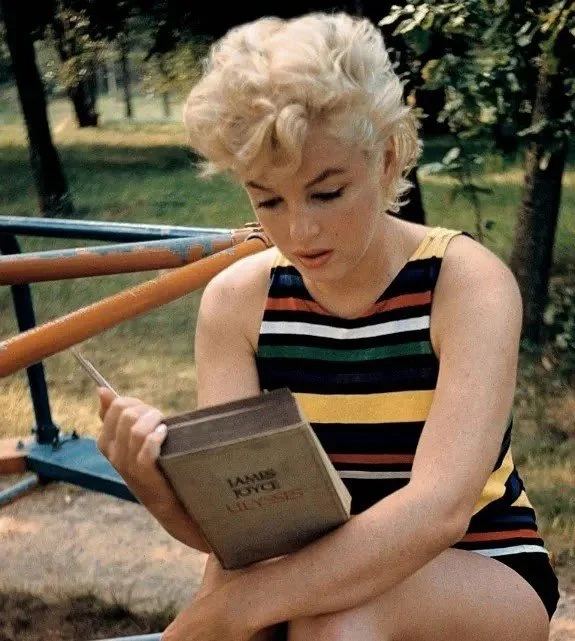
Marilyn Monroe kept a copy of Ulysses in her car.
Yes, that Marilyn. Bombshell. Insomniac. Bookworm.
According to her friend and photographer Eve Arnold, Marilyn said she loved the sound of it, reading it aloud to herself to try to make sense of it. She admitted it was ‘hard going’ but kept at it anyway.
You’re not alone, Marilyn.
Ulysses is notoriously challenging. Described as everything from a ‘verbal labyrinth’ to ‘an encyclopedia of obscenity’ (it was once banned in the U.S.), Joyce’s 1922 masterpiece is crammed with allusions, languages, and styles, hopping from Shakespeare to Latin to bawdy pub banter—all within a few pages.
It’s experimental. It’s maddening. It’s also hilarious and heartbreakingly human.
Joyce once said, ‘The longest way round is the shortest way home.' That applies here. Reading Ulysses may be long, winding, and weird, but for those who stick with it, the reward is profound: a glimpse into the messy, beautiful tangle of everyday life.
So, how do you begin to scale this literary Everest?
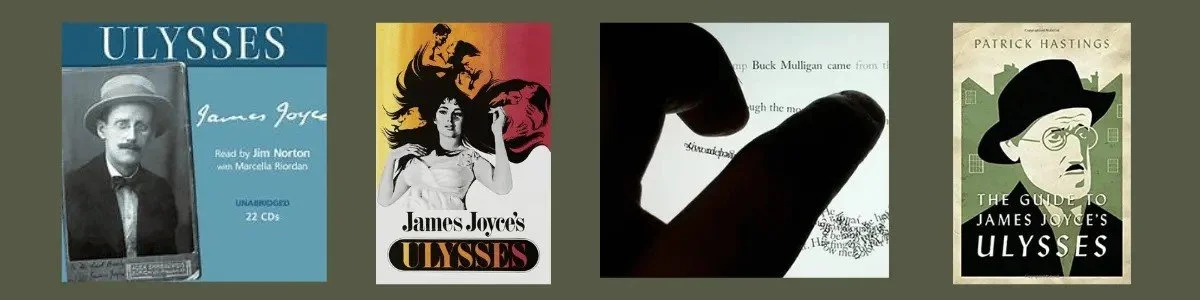
Four (very doable) Ways to Tackle Ulysses
1. Listen.
Let someone else do the heavy lifting. The audiobook version allows Joyce’s famously lyrical prose to really come to life. Try the abridged 4-hour version or go full beast mode with the 27-hour uncut epic. Especially useful for the final episode: Penelope. Molly Bloom’s stream-of-consciousness monologue that runs 40 pages long is in just EIGHT SENTENCES.
When punctuation abandons you, actors will not!
2. Watch
Joseph Strick’s 1967 film adaptation updates the setting to the 1960s but stays faithful to the text. If reading Ulysses feels like navigating a dreamscape, this film helps to anchor the story. And yes, it’s on YouTube.
Visuals help. So does wine.
3. Play
Yes, play. There’s an app called He Liked Thick Word Soup (blame Joyce) that turns pages of the novel into an interactive word puzzle. Think: finger gymnastics meets literary chaos. Bonus: You’ll absorb about four pages' worth of text while having fun.
Survival tip: Don’t try to understand every line—just enjoy the rhythm.
4. Cheat (Smartly)
You don’t have to go it alone. Patrick Hastings’ The Guide to James Joyce’s Ulysses and J. Michael O’Reilly’s Easy Ulysses offer annotated versions, historical context, and plot breakdowns. These aren’t cop-outs — they’re confidence boosts.
Skimming is not a sin. Especially with Joyce.
The Bluffer’s Guide: Say This at Literary Parties
Even if you haven’t cracked the spine, you can still hold your own. Learn these quickly!
Timeline? It all takes place on one day: June 16, 1904 (now known as Bloomsday).
Plot? A man walks around Dublin. That’s it. And somehow, it’s everything.
Fun Fact? U.S. physicist Murray Gell-Mann named the quark after a line from Finnegans Wake—Joyce's even stranger sequel to Ulysses.
Final chapter? Forty pages. Eight sentences. Molly Bloom lies in bed, remembering lovers, regrets, and the day she said "yes."
Theme? Through the eyes of his two central characters, Joyce describes every kind of human experience and pushes Celtic lyricism and vulgarity to beautiful extremes—including this from J. Michael O’Reilly:
“Love, death, sex, comedy, hope, failure, the daily grind, drinking sessions, every imaginable bodily function, the Ascot Gold Cup, adultery, discussions about Hamlet, racism, voyeurism, a visit to a brothel, wandering, homecoming, separation, reconciliation, loss of a child, a glass of Burgundy and a Gorgonzola sandwich.”
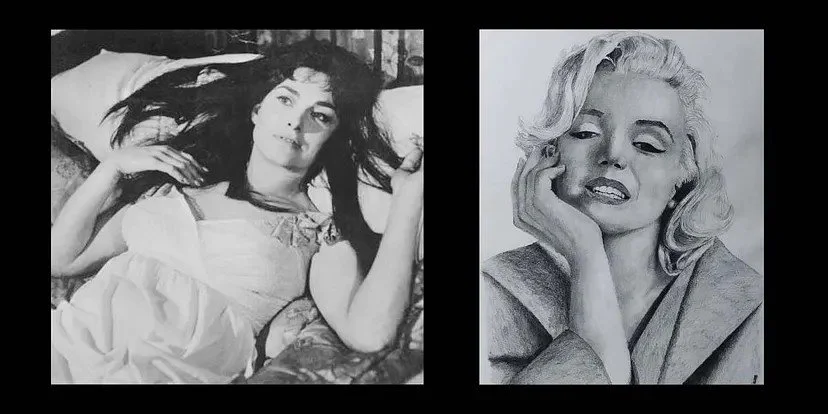
Barbara Jefford as Molly Bloom, Ulysses (1967 film) — Kresba Marilyn Monroe
Molly & Marilyn
In that famous photo, Marilyn’s copy of Ulysses is open to the final chapter—Penelope—the iconic soliloquy of Molly Bloom. Vulnerable. Sensual. Defiant.
Molly is a middle-aged woman whose career as a singer is fading. She’s in the midst of an affair, lying awake at night, questioning her life. Her monologue — written without punctuation — blurs thought, memory, fantasy, and truth.
Marilyn, too, knew insomnia. She lived in the glare of the public gaze, her image shaped by men. She, too, was so often misunderstood—sensual, yes, but also smart, self-aware, and deeply curious.
Both women — one fictional, one fiercely real — carry the tension between public expectation and private truth.
Perhaps reading Ulysses was Marilyn’s way of aligning with Molly. A quiet rebellion. A whispered “yes” to complexity.
“…and his heart was going like mad and yes I said yes I will Yes.”
That famous closing line is often seen as an affirmation of life, of love, of saying yes to all of it—the pleasure, the pain, the chaos.
Marcella Riordan reads from Molly’s Reverie in Ulysses
So here’s the real question:
If Marilyn could say yes to Joyce, to complexity, to being more than what the world expected —