
The Curious Case of Miss Personification
A Simple Technique to Make Your Writing More Memorable
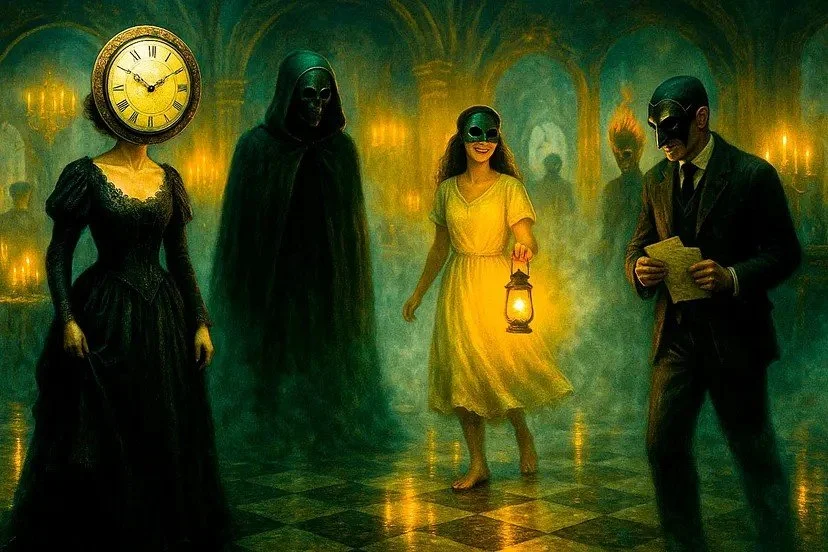
A Knock at the Door
It was a foggy sort of morning—the kind that makes your thoughts wander off without a coat. I was just settling in with a lukewarm cup of tea and an unreasonable deadline when she swept into the room.
Miss Personification, in all her florid, elusive splendor.
You never quite know when she’ll turn up. Sometimes she’s just a faint undertone—"Duty calls,” someone mutters, as if Duty were standing in the hallway like a disappointed aunt, arms folded. Or “Money talks,” they’ll sigh, though no one’s quite sure what language it speaks. These aren’t true appearances, you understand—more like shadows on the wall. Vague gestures. Half-hearted impersonations.
When She Really Shows Up
But when Miss Personification really arrives, she arrives. She doesn’t knock—she flings open the door and rearranges the lighting.
Work, for instance, becomes a man in a suit stuffed with rolled-up banknotes, holding a whip in one hand and a rota in the other. Work calls you up, flatters you into a weekend shift, and disappears before the coffee’s cold. A cruel fellow, Work — invincible.
Except, of course, when Lady Luck sends a lotto win your way. Then life exhales—your hours loosen, the silence sweetens, and even Time nods kindly as you pass. (I keep buying the tickets….)
Personification vs. Allegory
You see, there’s a scale to this sort of thing.
At one end, we have those casual phrases: work phoned, sleep beckons"—where personification barely dips a toe in.
At the other, full-blown allegory moves in and starts labeling your cupboards (Temptation above the biscuits, Procrastination sprawling across the desk drawer) and insists on renaming all your friends after character flaws. Your mate Jim? Now called Sloth. Your ex—betrayal. And that suspiciously cheerful neighbor with wind chimes and matching shoes? Delusion, obviously.
That’s when things get sticky. Allegory, bless her earnest boots, takes over the entire house. Think of The Pilgrim’s Progress, where Despair (and his long-suffering wife, Diffidence) trap you in a symbolic bog for several chapters.
A bit much for flash fiction, if you ask me.
Shakespeare’s Brushstroke Genius
Miss Personification, however, is best when glimpsed.
Shakespeare knew this. Oh, did he ever. Jealousy becomes a green-eyed monster. Not just any monster—one with specific ocular features and a taste for irony. Fear becomes pale-faced. Victory bold-faced. Time, that sly fellow, has inaudible feet and cruel hands.
Death? Ah, he’s another matter entirely—ragged, voracious, occasionally amorous (ask Juliet). But even Death is offered only in glimpses: an elbow here, a whisper there. That’s Miss Personification’s secret—she dazzles, then vanishes.
Later poets tried to court her.
Marvell gave Time a wingèd chariot. Milton borrowed Job’s “eyelids of the morning.” Keats tried to take her dancing, but by then she’d grown thin and pale and began staying home more often.
These days, she’s rare. Duty still calls, Money still murmurs—but Miss Personification isn’t what she used to be.
A Flash of Her Hem
Still, for those of us who write in small spaces—drabbles, microfiction, flash—she is pure gold.
A single touch from her hem can animate an abstract. Let Grief lean against the doorway. Let Regret roll its eyes. One moment. One line. That’s all you need.
Before She Vanishes Again…
So, my dear Inkwaver, if you see Miss Personification on your creative doorstep, offer her a seat—just not a spare room. She’ll never leave.